

Garage doors rarely fail without warning, but many properties treat spring problems as sudden events. What appears to be an unexpected breakdown is often the final stage of a long decline that was evident in smaller performance changes.
For property managers, facility managers, and building owners, hidden spring fatigue is a maintenance issue with operational consequences. It affects door balance, opener strain, safety, tenant access, and service call frequency. Technicians who diagnose spring fatigue correctly do more than replace broken parts. They identify early wear patterns, separate spring problems from track or opener issues, and help prevent repeat failures that disrupt loading areas, parking access, and daily building traffic.
Hidden Spring Fatigue Is a Silent Cost
- Why Spring Fatigue Gets Missed
Spring fatigue is easy to overlook because the door may continue operating while performance degrades. A fatigued torsion or extension spring can still lift and lower the door, but the system begins to compensate in ways that increase stress elsewhere. The opener works harder, the door travels unevenly, and noise patterns change gradually enough that occupants stop noticing.
That slow progression is why hidden fatigue often escapes routine checks. A technician may be called only after a no-open complaint, when the real issue has been developing for months. Property teams that track recurring door behavior and involve trained technicians earlier often avoid emergency calls, especially at high-use sites where access reliability matters as much as the door itself.
- Usage History Reveals Fatigue Risk
One of the first things technicians consider is cycle history. Garage door springs wear out from repeated opening and closing, not simply from age on the calendar. A spring in a lightly used storage garage may last much longer than one serving a busy multifamily parking entry, service bay, or delivery area that runs all day.
Technicians often ask practical questions before touching the system. How many users rely on the door, how often it cycles, whether usage increased after tenant turnover, and whether the door now serves a different purpose than originally planned all help frame the diagnosis. Teams managing multiple properties sometimes coordinate records through local vendors, and references in a College Station office service directory can help centralize maintenance history even when the business categories differ. The key point is simple: usage context changes how spring performance should be evaluated.
- Door Balance Tells The Real Story
A hidden spring fatigue diagnosis usually starts with door balance testing. Springs are designed to counter the weight of the door so it moves smoothly and remains controllable throughout its travel. As springs fatigue, they lose torque or tension, and the balance shifts. The door may feel heavier than it should, drift downward, or fail to hold position when manually moved.
Technicians use balance behavior to distinguish spring wear from opener problems. If the opener strains but the door is poorly balanced, replacing the opener will not solve the underlying issue. In many cases, opener symptoms are due to spring fatigue, not motor failure. This is why trained technicians often disengage the opener and evaluate manual movement first. It provides a clearer picture of the spring condition than listening to the operator alone.
- Travel Speed Changes Signal Trouble
Hidden fatigue often appears as subtle travel changes before a spring break. Technicians watch for doors that start smoothly but slow near the midpoint, doors that jerk at certain points, or doors that close faster than normal near the floor. These motion changes can indicate uneven spring force, declining tension, or imbalance between paired springs.
In torsion systems with two springs, one may fatigue faster than the other, especially if prior replacements were mismatched or performed at different times. That creates an uneven lift force, affecting cable tension and door tracking. Technicians diagnose this by observing movement symmetry and comparing component conditions across both sides of the system. For property managers, these changes are useful warning signs because tenants often report them as strange movement rather than saying the spring is failing.
- Opener Strain Often Masks Spring Wear
Many service calls begin with complaints about remotes, wall controls, or openers that sound louder than usual. Technicians still inspect controls and operator settings, but hidden spring fatigue is often the deeper cause. When springs lose lifting force, the opener is forced to carry more of the door’s weight than it was designed to handle.
This added load shows up in practical ways. The opener may hesitate, reverse unexpectedly, or trigger force limits. Chains and belts may become noisier, and operator housings may vibrate more during travel. A technician diagnosing correctly will not stop at the first symptom. They look at whether the door is asking the operator to do the spring’s job. That distinction matters because replacing opener components without correcting spring fatigue usually leads to repeated failures and wasted maintenance spending.
- Visual Inspection Exposes Fatigue Patterns
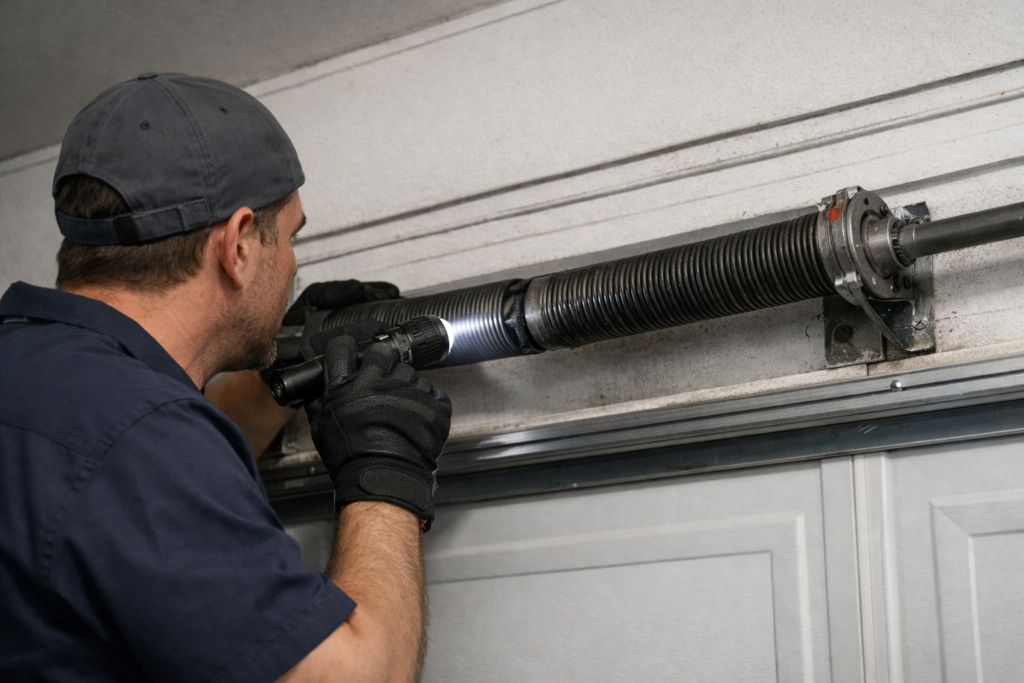
Technicians also rely on close visual inspection to identify spring fatigue before full breakage occurs. On torsion springs, they look for spacing changes between coils, surface wear, corrosion, distortion, and signs of past overstress. On extension springs, they check stretch consistency, hook wear, and deformation at connection points. These signs may be subtle, but they become more meaningful when paired with balance and movement symptoms.
Corrosion is especially important in humid or partially exposed environments because it can accelerate fatigue and reduce the effective life of the spring. A spring may still be intact yet significantly weakened due to corrosion-related pitting and stress concentration. Property teams often focus on visible rust as a cosmetic issue, but technicians treat it as a reliability indicator when diagnosing hidden fatigue in high-cycle doors.
Better Diagnosis Protects Access And Equipment
Garage door technicians diagnose hidden spring fatigue by combining usage history, balance testing, movement observation, visual inspection, sound analysis, and system-wide hardware checks. The process is practical, not guesswork. It focuses on how the door behaves under load and how spring performance affects everything connected to it.
For property managers, facility managers, and building owners, the value is straightforward. Accurate spring fatigue diagnosis reduces emergency breakdowns, protects openers and hardware from overload, and keeps doors operating reliably in the areas where access matters most. A spring failure may look sudden, but it rarely is. The earlier the warning signs are recognized, the easier it is to turn a disruptive repair into a planned maintenance decision.