
Heating complaints often start with comfort rather than safety. A building takes longer to reach setpoint, some zones feel slow to warm, or a rooftop unit short-cycles on cold mornings, and the issue is blamed on controls, filters, or thermostat calibration. Sometimes that is true. Sometimes the deeper problem is a heat exchanger beginning to deteriorate behind the access panel.
For property managers, facility managers, and building owners, early detection is crucial because heat exchanger deterioration can disrupt operations long before a full failure. It affects combustion stability, heat transfer, runtime, and shutdown behavior in ways that appear to be ordinary maintenance issues. Contractors who catch the pattern early rely on disciplined inspection, operating data, and practical field testing rather than waiting for obvious damage to force an emergency response.
Why does heat exchanger damage start quietly
- Deterioration starts before visible failure appears
Heat exchangers work under repeated thermal stress. Every heating cycle expands metal, then allows it to contract as the burner shuts down. Over time, that constant movement weakens sections around bends, seams, welds, and high-heat zones. The process is gradual, which is exactly why it is often missed during rushed service visits.
Contractors know the absence of a visible crack does not mean the exchanger is in good condition. Early deterioration often first appears as distortion, uneven heating, or changes in airflow through the exchanger passages. These shifts can affect performance and burner behavior months before a dramatic failure occurs. Identifying those changes early gives building teams time to plan repairs or replacement without losing heat during peak demand.
- Operating history often reveals hidden stress.
A strong diagnosis starts with how the system has been behaving, not just what it looks like on the day of inspection. Contractors ask about recurring lockouts, rising gas consumption, uneven heating complaints, and changes in runtime during similar weather conditions. A unit that has become slower to satisfy demand may be signaling reduced heat transfer, not just thermostat drift.
In many service markets, property teams call a contractor after multiple small issues stack up rather than one large failure, and a provider, such as a Greer, SC, HVAC Company, may be brought in specifically because it can read those patterns across maintenance history and current performance. That timeline matters. Heat exchanger deterioration rarely appears as a single symptom, but it often leaves a trail in service notes and tenant complaints.
- Flame behavior exposes internal airflow changes.
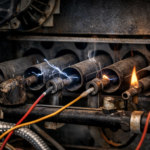
One of the earliest clues is at the burner. A healthy heat exchanger supports stable combustion by maintaining expected airflow and draft conditions. When exchanger passages begin to distort, scale, or overheat unevenly, flame behavior may change. Contractors look for flickering, wavering, rollout tendencies, or flame movement that seems inconsistent once the blower starts.
These observations are not treated casually. Flame instability can point to changes in pressure relationships and airflow caused by exchanger condition, not only burner issues. A contractor compares startup flame characteristics to operation under full airflow because some deterioration signs only appear after the blower engages and the metal expands further. That timing-based observation helps separate exchanger-related problems from ignition or gas valve issues.
- Temperature patterns tell a practical story.
Heat exchangers are designed to transfer heat predictably. When deterioration begins, that transfer becomes less uniform. Contractors check the temperature rise across the unit and compare it to manufacturer ranges, but they also assess how stable that rise remains throughout a full heating cycle. A drifting temperature profile can indicate internal stress or restricted heat transfer surfaces.
They also examine supply air consistency at the unit and downstream. If the system is operating with clean filters and proper blower settings but still shows inconsistent heating delivery, the exchanger moves higher on the suspect list. This approach matters in commercial properties where comfort complaints are often attributed to duct balancing first. Contractors use temperature behavior to determine whether the root issue is distribution-related or starting inside the furnace or rooftop heating section.
- Visual inspection goes beyond obvious cracks.
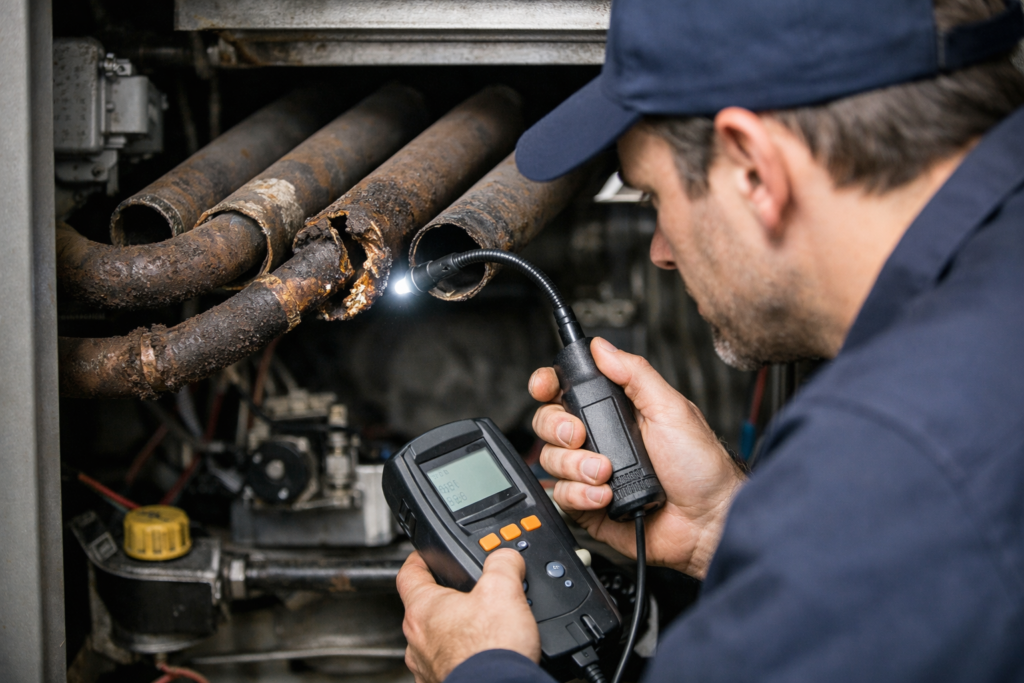
Visual inspection remains essential, but experienced contractors are not only searching for a dramatic split in metal. Early deterioration often appears as subtle warping, surface scaling, discoloration, or stress marks at seams and bends. They inspect accessible sections with mirrors, borescopes, and lighting that helps reveal contour changes that are easy to miss during a quick look.
Discoloration is especially useful when interpreted correctly. Areas that appear darker, bluer, or more oxidized than the surrounding metal can signal abnormal heat concentration. Contractors compare these zones with burner alignment, airflow conditions, and soot patterns to understand whether the exchanger is overheating unevenly. A surface mark alone is not a diagnosis, but in context, it can be an early warning that the metal is operating under strain.
Reliable heating starts with an earlier diagnosis.s
Heat exchanger deterioration does not begin on the day a unit fails. It develops through thermal stress, airflow changes, and material fatigue, leaving clues in flame behavior, temperature performance, control trips, combustion readings, and visual condition. HVAC contractors who diagnose these signals early protect building continuity and reduce the odds of a disruptive mid-season shutdown.
For facility managers and property owners, the practical takeaway is simple: recurring heating irregularities deserve a deeper look when they persist after routine maintenance. Early detection creates options. Waiting for a visible failure removes them, and the cost of that delay is usually measured in downtime, urgency, and avoidable disruption.