
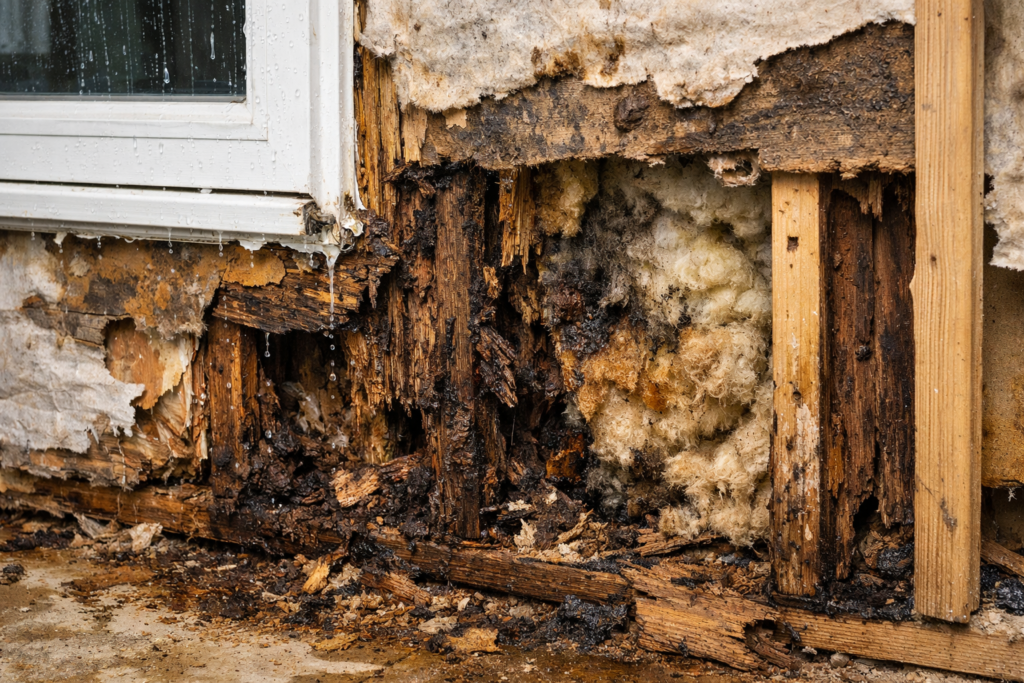

Moisture rarely announces itself with a dripping ceiling or a puddle on the floor. More often, it slips behind trim, stains nothing, and quietly eats away at framing for years. One of the most common ways that happens is through a window that “looks fine” from the outside but was flashed incorrectly from day one.
For property managers and building owners, hidden wall rot is a budget ambush: tenants notice drafts, paint starts bubbling, or a musty odor shows up in one unit, and suddenly you’re opening a wall that should have lasted decades. Improper window flashing is a frequent root cause because it turns a normal rain event into a repeatable leak path—small amounts of water, delivered consistently, with nowhere safe to drain.
Why “Looks Fine” Windows Still Leak
- Why are windows natural water targets
Windows interrupt the building envelope, and every interruption must be treated like a controlled drainage point. Wind-driven rain hits the glass and frame, then runs to the edges where it finds seams, fastener holes, tiny gaps, and corners. Even a high-quality window can’t compensate for a bad integration with the wall system. When flashing is missing, reversed, or poorly lapped, water is guided inward rather than outward.
This matters more than many teams realize because walls are designed to tolerate a little moisture, not repeated wetting. Once water reaches wood sheathing, framing, or paper-faced drywall, drying becomes slow and inconsistent. That’s when decay organisms and mold find a stable home, often without any immediate interior signs.
- The flashing job isn’t “optional trim.”
Flashing is not decoration. It’s a set of layered components—typically a sill pan or equivalent, side flashing, head flashing, and compatible membranes—installed in a specific order so gravity and drainage work in your favor. The purpose is simple: any water that gets past the exterior surface should be directed back out before it can soak into the wall assembly.
This is why a qualified Window Replacement Company should talk as much about integration details as about frame materials or U-values. If the install plan doesn’t clearly describe how water will drain at the sill and how layers will be shingled at the head, you’re not buying an upgrade; you’re buying a new opening for moisture to enter.
- The “backwards layering” mistake that traps water
The most damaging flashing errors often look neat. A common one is reversing the lap sequence so that the upper layers sit behind the lower layers, creating a funnel into the wall. Another is relying on sealant as the primary defense. Sealants fail. They shrink, crack, pull away from substrates, and degrade under UV exposure and movement. When sealant is treated as the system rather than a backup, a small failure can become a recurring leak.
Equally risky is the absence of a true sill pan or an equivalent strategy that collects and drains water to the exterior. Without that, any moisture that sneaks in around the lower corners tends to pool on the framing, wetting the same areas repeatedly. You may never see water on the floor because it’s being absorbed and redistributed inside the wall cavity.
- How hidden rot develops without obvious leaks
Rot is a process, not an event. Improper flashing typically allows small volumes of water to enter during rain, especially in wind-driven conditions. That water often comes into contact with oriented strand board, plywood, studs, and insulation. Insulation can mask the problem by holding moisture against wood while keeping the interior surface relatively warm and dry-looking. Over time, wood fibers break down, fasteners corrode, and the wall’s structural integrity around the opening diminishes.
Early symptoms are easy to misread. A unit may have a recurring mildew smell, persistent complaints of condensation, or slightly warped trim. Maintenance may repaint, recaulk, or replace interior finishes, temporarily “fixing” the symptom while the wall continues to degrade. By the time the exterior shows soft spots or staining, the damage behind the cladding can be extensive.
- Cladding and drainage planes complicate the story.
Modern wall systems are layered, and each layer must work with the others. Flashing must tie into the weather-resistive barrier and respect the drainage plane behind the cladding. When installers cut, patch, or tape membranes without continuity, water can bypass the intended path and move laterally. Some claddings, such as stucco and adhered stone, are particularly unforgiving because they can store moisture and release it slowly, keeping the opening wet long after the storm ends.
Transitions are where failures concentrate: window-to-sill interfaces, head conditions under eaves, and corners where multiple materials meet. Even a small misalignment—membrane not adhered, wrinkles that channel water, incompatible tapes that let go—can become a reliable leak route. The problem is not always “a bad window.” It’s often a bad connection between the window and the wall.
The quiet leak that becomes a capital problem
Improper window flashing doesn’t fail loudly. It fails repeatedly, in small doses, in the places you least want moisture to live. That’s why hidden wall rot so often surprises otherwise diligent owners: the window looks intact, the room feels normal, and maintenance fixes seem to hold—until they don’t.
Treat window openings as high-consequence intersections, not routine replacements. When flashing is properly layered and integrated with the wall’s drainage strategy, the building can handle rain without drama. When it isn’t, every storm becomes a slow test of your framing, your finishes, and your operating budget.
Read also: How do Businesses Track Annual Permit Renewal Deadlines Efficiently Without Last-Minute Scrambles?