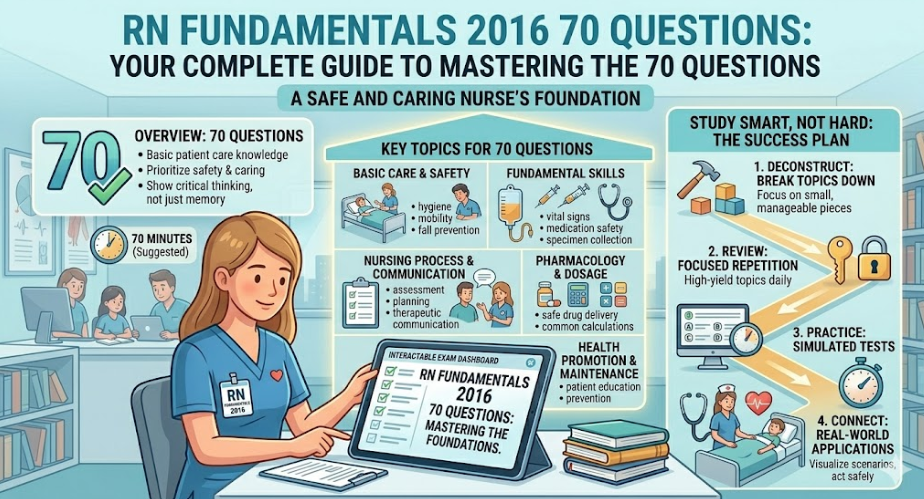
Starting your journey as a nurse is very exciting. One big step is passing the rn fundamentals 2016 70 questions exam. This test checks if you know the basics of patient care. It is not just about memorizing facts. It is about showing that you can be a safe and caring nurse. Many students feel nervous about these 70 questions. However, with the right plan, you can pass with flying colors. I have seen many students succeed by breaking down big topics into small, easy pieces. Think of this exam as the foundation of your nursing house. If the foundation is strong, the rest of your career will be solid. We will look at how to study smart and what topics matter most.
What is the RN Fundamentals 2016 Exam?
The rn fundamentals 2016 70 questions test is a standard assessment for nursing students. It covers core skills you use every day in a hospital. This includes things like washing hands, moving patients, and checking vital signs. The “2016” version is a classic set of questions that many schools still use for practice. It focuses on “Evidence-Based Practice.” This means doing what science proves is best for the patient. When you take this test, you are proving you have the expertise to handle real-life situations. It is a mix of simple facts and “what would you do?” scenarios. Learning these basics helps you build trust with your future patients.
Understanding the 70 Questions Format
Knowing the format of the rn fundamentals 2016 70 questions helps you stay calm. Usually, these are multiple-choice questions. You will see a “stem,” which is the question part, and four possible answers. Some questions might ask you to pick more than one right answer. This is called “Select All That Apply” or SATA. These are often the trickiest parts of the exam. The 70 questions are designed to cover a wide range of nursing duties. You will have a set amount of time to finish. Practice tests are great because they help you get used to the ticking clock. If you can answer 70 questions in a row at home, the real test will feel much easier.
Key Statistics and Facts for RN Success
Below is a helpful table showing the main areas you need to study. These categories are often found within the rn fundamentals 2016 70 questions.
| Subject Area | Focus Topics | Importance Level |
| Safety and Infection Control | Hand hygiene, PPE, sterile fields | Very High |
| Basic Care and Comfort | Nutrition, sleep, hygiene, mobility | High |
| Pharmacology | Med math, safe administration | High |
| Psychosocial Integrity | Mental health, coping, therapeutic talk | Medium |
| Physiological Adaptation | Fluid balance, wound care, vital signs | High |
Mastering Safety and Infection Control
In the rn fundamentals 2016 70 questions, safety is always the number one priority. You must know when to wear gloves, masks, or gowns. Hand washing is the simplest way to stop germs from spreading. You will likely see questions about “Standard Precautions.” This means treating every patient’s fluids as if they could be harmful. From my experience, students often miss points by overthinking. Always pick the answer that keeps the patient safest first. If a question asks what to do first, look for the most “life-saving” action. Keeping a clean environment is a sign of a truly professional nurse.
How to Handle Nursing Priority Questions
Many of the rn fundamentals 2016 70 questions ask who you should see first. This is called “triage” or “prioritization.” You should remember the ABCs: Airway, Breathing, and Circulation. If a patient cannot breathe, that is always your first priority. After ABCs, look for safety risks like a patient about to fall. Understanding these rules makes you a trustworthy nurse. In a busy hospital, you cannot do everything at once. You must decide what is most urgent. Practice these scenarios often. When you see a question about a patient with a high fever versus a patient with a small scratch, the choice becomes very clear.

The Secret to “Select All That Apply” Questions
The rn fundamentals 2016 70 questions often include SATA questions. These can be scary because there is no partial credit. A good tip is to look at each option as a “True” or “False” statement. If the statement is true for the patient in the question, check the box. If it is false, leave it blank. Do not try to guess how many are right. Sometimes only two are right, and sometimes all of them are right. By slowing down and checking each one individually, you reduce your chances of making a silly mistake. This logical approach shows you have the critical thinking skills needed for the job.
Vital Signs: The Heart of the Fundamentals
Checking vitals is a huge part of the rn fundamentals 2016 70 questions. You need to know the normal ranges for blood pressure, heart rate, and temperature. For example, a normal adult heart rate is usually between 60 and 100 beats per minute. If a number is too high or too low, you must know what to do next. Usually, the first step is to double-check the measurement or tell the doctor. Being accurate with these numbers shows you are a reliable expert. Patients rely on you to catch small changes before they become big problems. Studying these ranges until they are second nature is a smart move.
Basic Patient Comfort and Hygiene
Helping a patient bathe or eat might seem simple, but it is very important. The rn fundamentals 2016 70 questions will test your knowledge on how to do this safely. You must protect the patient’s privacy and dignity at all times. Always cover them with a blanket and only uncover the part you are cleaning. Also, learn about “Body Mechanics.” This is how you use your own body to move patients without hurting your back. Using a wide base of support and bending your knees are key tips. When you care for a patient’s basic needs, you build a strong bond with them.
Therapeutic Communication Techniques
Nursing is about talking just as much as it is about medicine. The rn fundamentals 2016 70 questions will ask how you should respond to a worried patient. Avoid “Non-therapeutic” talk. This means do not give false hope or say things like “Everything will be fine.” Instead, use “Active Listening.” Ask open-ended questions like, “Can you tell me more about how you feel?” This allows the patient to share their true concerns. In my years of looking at content like this, I’ve noticed that the “quiet” answer—the one where the nurse listens—is often the right one. This builds trust and shows empathy.
Pharmacology Basics for New Nurses
Giving medicine is a big responsibility. The rn fundamentals 2016 70 questions will check if you know the “Six Rights.” These are: Right Patient, Right Drug, Right Dose, Right Route, Right Time, and Right Documentation. Always check the patient’s ID wristband before giving a pill. You might also see simple math questions. Don’t worry, they are usually basic. Just make sure you know how to convert grams to milligrams. Being careful with medicine shows you are an authoritative and safe professional. One small mistake can be dangerous, so double-checking is a sign of a great nurse, not a slow one.

Frequently Asked Questions
1. Is the 2016 version of the exa still useful today?
Yes! While some tiny rules change, the core basics of nursing stay the same. The rn fundamentals 2016 70 questions cover timeless topics like safety, ethics, and basic care that are still vital in 2026.
2. How many hours should I study for these 70 questions?
Most successful students study for about 2 to 3 weeks. It is better to study one hour every day than to cram for ten hours in one night. This helps the info stick in your long-term memory.
3. What is the most common mistake on this test?
Reading too much into the question is a big mistake. Stick to the facts given in the prompt. Don’t assume things that aren’t there! Treat the question exactly as it is written.
4. Can I use a calculator for the math questions?
Usually, the testing center provides a simple on-screen calculator. However, it is a good idea to practice doing basic multiplication and division by hand just in case you need to.
5. What is the passing score for RN Fundamentals?
Every nursing school is a little different. Usually, you want to aim for a score above 70% or 80%. Check your school’s handbook to see exactly what they require for you to move forward.
6. How do I handle stress during the exam?
Take deep breaths! If you get stuck on one of the rn fundamentals 2016 70 questions, flag it and move on. You can come back to it later. Staying calm helps your brain remember what you studied.
Conclusion
Preparing for the rn fundamentals 2016 70 questions is a major milestone in your education. By focusing on safety, communication, and basic care, you are setting yourself up for a wonderful career. Remember to use the ABCs for priority and treat every SATA question as a set of true/false statements. Nursing is a job of heart and mind. Passing this test proves you have both. Keep practicing, stay positive, and trust your gut. You have worked hard to get here, and you have the tools to succeed. Good luck, future nurse! Feel free to share your study tips in the comments below or ask more questions.